
Guide
LiFePO4 cell voltage difference: what’s normal, and when to worry
Your battery is a row of cells in series. When they drift apart, the battery gives less and the board trips sooner. Here’s how to read the difference between your cells.
What the cell difference is
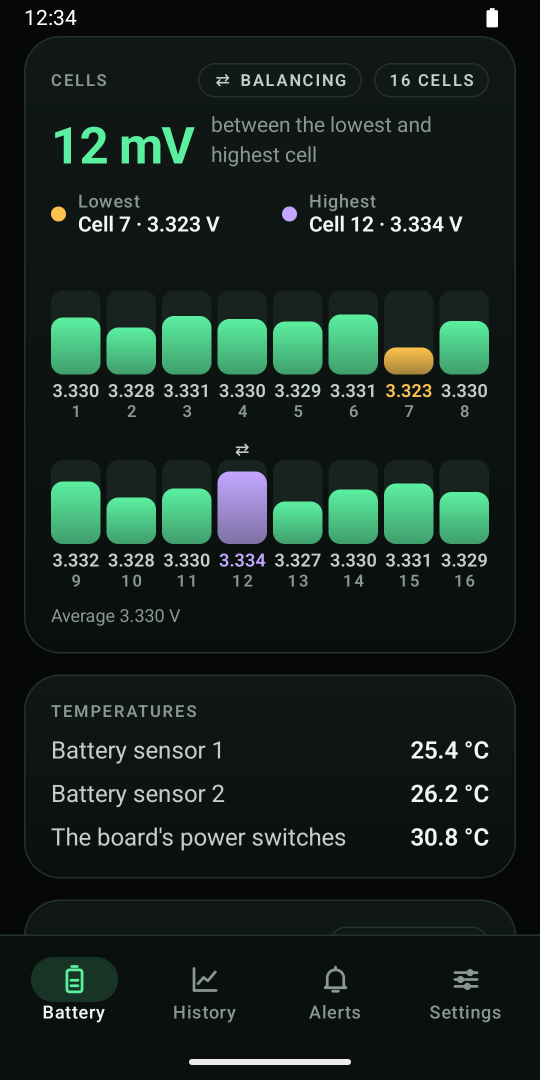
A 12 V LiFePO4 battery has 4 cells in series, a 48 V home battery 15 or 16. The board (the BMS) measures each one. The difference, often called the delta, is the highest cell’s voltage minus the lowest, in millivolts (mV). 3.334 V and 3.322 V are 12 mV apart.
The whole battery is only as good as its weakest cell. When one cell reaches empty first, the board switches the battery off, even though the others still have charge. When one cell reaches full first, the board stops the charge early.
What’s normal
Look at the difference when the battery is resting in the middle of its charge (the cells between about 3.25 V and 3.33 V). As a rough guide:
| Difference at rest, mid-charge | What it usually means |
|---|---|
| Under 20 mV | Well balanced. |
| 20 to 50 mV | Fine, but keep an eye on it. |
| Over 50 mV | The pack needs balancing, or one cell is weaker. |
| Over 100 mV | Ask your installer or the battery’s maker. |
Why it jumps near full and near empty
LiFePO4 cells hold an almost flat voltage through the middle of their charge. Near full (above about 3.40 V) and near empty (below about 3.10 V) the voltage changes fast, so a small difference in charge shows up as a big difference in voltage.
- A 10 mV difference in the middle can become 100 mV or more at the very top of a charge. That’s normal for a slightly unbalanced pack.
- The top of the charge is where you see how well balanced the pack really is, and it’s where most boards balance.
- If the same cell is always the first to hit the top or the bottom, that cell has less capacity than the rest.
How balancing works
The board evens the cells out by moving or burning off a little charge. Most boards only balance when the cells are above a set voltage and further apart than a set difference, so a pack that never charges full never gets balanced.
- Passive balancing (many JBD and Daly boards) burns off small currents from the highest cells, slowly.
- Active balancing (JK boards) moves charge from the highest cells to the lowest, much faster.
If the difference keeps growing, the battery is probably not getting full often enough, or a cell is getting weaker. A full charge, held at the top for a while, often brings it back.
Never open a battery or change its wiring unless you know what you’re doing. Cells hold a lot of energy. Talk to your installer or the battery’s maker.
Keep an eye on it with CellBoss
- The live screen shows every cell, the lowest and highest marked, the difference in mV, and when the board is balancing.
- History PRO shows the cell difference by day, week and month, so you see it creep up long before it trips the battery.
- An alert PRO while CellBoss is open when the cells are more than a set difference apart for a minute (50 mV to start with; you choose).
Questions
What is a good cell voltage difference for LiFePO4?
Under 20 mV at rest in the middle of the charge is well balanced. Up to 50 mV is fine to watch. More than that means the pack needs balancing or a cell is weaker.
Why are my cells 150 mV apart when the battery is full?
Near full, the cell voltage climbs fast, so a small imbalance looks big. Check the difference again once the battery has rested in the middle of its charge, and keep it charging to full so the board can balance.
Why does my battery switch off when it still shows charge?
Usually one cell reached the board’s low-voltage limit before the others. Look at the lowest cell when it happens: if it’s always the same one, that cell is weaker or the pack needs balancing.
How do I balance LiFePO4 cells?
Let the board do it: charge the battery full and leave it on the charger for a while, so the board can balance at the top. Opening a pack to balance cells by hand is a job for someone who knows how.
Read next: the LiFePO4 voltage chart and how to check your battery’s health.